Wednesday, November 24, 2010
Tuesday, November 23, 2010
Independence by Intoxication
The brewing of Beer and distilling of Brandy is not a subject easily thought of as a thriving part of the repertoire of our once theocratic ruled Moravian town of Salem. In today’s “Bible Belt” brewing, distilling of alcoholic beverages and religion don’t fit well in the same thought. Not so in the 1700’s. This was not the “Bible Belt” and the Moravian’s can’t be compared to today’s pious religious folk we might be acquainted with. On thing I have learned about many pious Moravians, even today, they can hold their liquor. That is another story. The Salem Single Brothers Brewery and Distillery opened in 1774. There were similar operations in Bethabara. Their fame for quality brewing and distilling spread throughout the Carolina backwoods and beyond.
The pious Moravian’s of Salem choose to remain publicly neutral during the Revolutionary War. Some might think of them as not willing to fight. Such is not the case. The Moravian’s were forced to walk a narrow line because of their relationship with the British concerning their land. It was a complicated relationship. Many individual Moravians participated in the war, including many of my ancestors. The truth is that Traugott Bagge, Salem’s leading merchant of the church owned store, was actively involved on the Patriot side practically serving as a purchasing agent for the Continental Army. The village of Bethania was a little more openly patriotic than Salem and Bethabara. These contradictions led to be accusations, looting and damages from both sides. The Moravians never knew from day to day who might appear in the town, friend or foe, and what demands, reasonable or unreasonable might be thrust upon them. Although receipts for aid supplied to the patriot cause could be used later to pay taxes, lightening the costs of food, lodging and other supplies, they worried for the safety of their homes and their children.
The superiority of the Moravians brewing and distilling achievements were a well known draw and very popular among visitors and travelers. Salem’s reputation in the art of good drink spread rapidly and reached British General Lord Cornwallis who managed to make the area of Salem an important part of his chase to destroy the patriot army following the battle of Kings Mountain. Amazingly when he should have been traveling North East to cut General Greene off at river crossings instead he chose to travel East through the supply (beer and brandy) rich Moravian settlements.
Earlier in August of 1780, Bethabara, with only 42 adults in residence, had been overrun by three hundred Virginia militia men, who camped in the town for three weeks. After the battle of Kings Mountain in October, where loyalist troops were defeated by the over-the-mountain men using Indian fighting tactics and more accurate long rifles, Bethabara hosted five hundred prisoners for nineteen days. Some of the prisoners were sent to Salem. Prisoners in both towns were guarded by members of my family, who were not Moravian, per their military pension records.
At one point about a dozen of General Greene’s men rode into town, they “lived at discretion in the town,” the Salem Diary complained. They got drunk at the tavern and threatened the lives and homes of several brothers and sisters, including Brother Bagge, twice holding a pistol to his breast.
On the evening of February 4th 1781 the Continental Army’s General Nathaniel Greene and his troops marched through Salem and received supplies. Greene then moved on to Guilford Courthouse arriving on the 6th where others joined them. A few days later Lord Cornwallis and his British army, in pursuit of General Greene, arrived in the area of Salem and wanted supplies for their troops as well. The Moravians provided the British with brandy, oxen and bread, but unfortunately the troops also looted the areas stores and homes.
Lord Cornwallis and his British army of about 3,000 men took over the area around the village of Bethania. Many troops camped on Fredrich Muller’s farm. Cornwallis’ actions seemed to be a warning to Bethania for their more vocal support of the American cause than most Moravian communities. As cold rain fell, the soldiers butchered more than 60 head of cattle, plus sheep, chickens and geese. As they prepared their meals in the different quarters they had taken over, they purposely tracked in mud from the unpaved streets. As darkness set in,100 gallons of whiskey and 300 hundred pounds of bread, sent from Bethabara, added to their meals.
Many of the soldiers must have been drunk later in the evening when someone decided that the Moravians ought to drink to the health of good King George. The men at first refused and were threatened with swords. They then took the bottle, tipped it up, letting it gurgle, but not swallowing any of the brandy. Cornwallis spent the night at a home in Bethania. Much property was destroyed and they held the minister as hostage until all the best horses could be delivered. Cornwallis ordered 20 fresh horses were to be ready at 6 A.M. the next morning. The Moravians tried to explain that they could not supply so many horses. The army left finally with 17 horses, six of which had been freshly stolen from the British army itself.
Leaving the area, Lord Cornwallis and his army marched through Salem. Apparently, Cornwallis socialized with leaders of the community including Bagge who had recently returned from a visit to Europe. On their rampage they haled ninety barrels or so of Salem’s best brew off toward their impending confrontation with Greene at Guilford Courthouse.
Several days later, nearly five hundred cavalry troops camped in Salem, throwing the town into chaos. As well as unruly soldiers, there were civilian families of men, women, and children who had placed themselves under “protection” of the British army. British soldiers stole from the store and from residences, even snatching the wash off the clothesline at one home
On March 15th 1781 Generals Greene and Cornwallis met at the Battle of Guiford Court House (in present day Greensboro named after General Greene). This battle is considered to be one of the hardest-fought of the entire war; “I never saw such fighting,” Cornwallis later declared, “since God made me.” The Earl displayed his courage and tenacity as a combat commander (at one point, he ordered the artillery to shell the lines his own men were fighting in) but also his deficiencies as a strategist. Could it have been the effect Moravian brewing and distilling? Although the British troops held the field at the end of the battle, their casualties at the hands of the numerically superior American Army were crippling. Following this "Pyrrhic (costly) victory", Cornwallis chose to move to the Virginia coastline to get reinforcements and to allow the Royal Navy to protect his battered army. This decision eventually resulted in Cornwallis's defeat at Yorktown, Virginia later in 1781. The Patriots' victory there guaranteed American independence.
Was it the long rifles of the Quaker “Pacifists,” recently settled in Guilford or the intoxicating brew of the “neutral” pious Moravian brethren leading to the British poor performance at Guilford Court House in the last great decisive battle of the South?
The pious Moravian’s of Salem choose to remain publicly neutral during the Revolutionary War. Some might think of them as not willing to fight. Such is not the case. The Moravian’s were forced to walk a narrow line because of their relationship with the British concerning their land. It was a complicated relationship. Many individual Moravians participated in the war, including many of my ancestors. The truth is that Traugott Bagge, Salem’s leading merchant of the church owned store, was actively involved on the Patriot side practically serving as a purchasing agent for the Continental Army. The village of Bethania was a little more openly patriotic than Salem and Bethabara. These contradictions led to be accusations, looting and damages from both sides. The Moravians never knew from day to day who might appear in the town, friend or foe, and what demands, reasonable or unreasonable might be thrust upon them. Although receipts for aid supplied to the patriot cause could be used later to pay taxes, lightening the costs of food, lodging and other supplies, they worried for the safety of their homes and their children.
The superiority of the Moravians brewing and distilling achievements were a well known draw and very popular among visitors and travelers. Salem’s reputation in the art of good drink spread rapidly and reached British General Lord Cornwallis who managed to make the area of Salem an important part of his chase to destroy the patriot army following the battle of Kings Mountain. Amazingly when he should have been traveling North East to cut General Greene off at river crossings instead he chose to travel East through the supply (beer and brandy) rich Moravian settlements.
Earlier in August of 1780, Bethabara, with only 42 adults in residence, had been overrun by three hundred Virginia militia men, who camped in the town for three weeks. After the battle of Kings Mountain in October, where loyalist troops were defeated by the over-the-mountain men using Indian fighting tactics and more accurate long rifles, Bethabara hosted five hundred prisoners for nineteen days. Some of the prisoners were sent to Salem. Prisoners in both towns were guarded by members of my family, who were not Moravian, per their military pension records.
At one point about a dozen of General Greene’s men rode into town, they “lived at discretion in the town,” the Salem Diary complained. They got drunk at the tavern and threatened the lives and homes of several brothers and sisters, including Brother Bagge, twice holding a pistol to his breast.
![]() |
| General Nathaniel Greene |
Lord Cornwallis and his British army of about 3,000 men took over the area around the village of Bethania. Many troops camped on Fredrich Muller’s farm. Cornwallis’ actions seemed to be a warning to Bethania for their more vocal support of the American cause than most Moravian communities. As cold rain fell, the soldiers butchered more than 60 head of cattle, plus sheep, chickens and geese. As they prepared their meals in the different quarters they had taken over, they purposely tracked in mud from the unpaved streets. As darkness set in,100 gallons of whiskey and 300 hundred pounds of bread, sent from Bethabara, added to their meals.
Many of the soldiers must have been drunk later in the evening when someone decided that the Moravians ought to drink to the health of good King George. The men at first refused and were threatened with swords. They then took the bottle, tipped it up, letting it gurgle, but not swallowing any of the brandy. Cornwallis spent the night at a home in Bethania. Much property was destroyed and they held the minister as hostage until all the best horses could be delivered. Cornwallis ordered 20 fresh horses were to be ready at 6 A.M. the next morning. The Moravians tried to explain that they could not supply so many horses. The army left finally with 17 horses, six of which had been freshly stolen from the British army itself.
![]() |
| Lord Cronwallis |
Several days later, nearly five hundred cavalry troops camped in Salem, throwing the town into chaos. As well as unruly soldiers, there were civilian families of men, women, and children who had placed themselves under “protection” of the British army. British soldiers stole from the store and from residences, even snatching the wash off the clothesline at one home
On March 15th 1781 Generals Greene and Cornwallis met at the Battle of Guiford Court House (in present day Greensboro named after General Greene). This battle is considered to be one of the hardest-fought of the entire war; “I never saw such fighting,” Cornwallis later declared, “since God made me.” The Earl displayed his courage and tenacity as a combat commander (at one point, he ordered the artillery to shell the lines his own men were fighting in) but also his deficiencies as a strategist. Could it have been the effect Moravian brewing and distilling? Although the British troops held the field at the end of the battle, their casualties at the hands of the numerically superior American Army were crippling. Following this "Pyrrhic (costly) victory", Cornwallis chose to move to the Virginia coastline to get reinforcements and to allow the Royal Navy to protect his battered army. This decision eventually resulted in Cornwallis's defeat at Yorktown, Virginia later in 1781. The Patriots' victory there guaranteed American independence.
Was it the long rifles of the Quaker “Pacifists,” recently settled in Guilford or the intoxicating brew of the “neutral” pious Moravian brethren leading to the British poor performance at Guilford Court House in the last great decisive battle of the South?
Monday, November 22, 2010
Moravians NOT THE FIRST!
As an adult history has gained a rich interest in my life. I have come to realize that a great deal of what I thought was history apparently was what someone desired for me to believe and not reality. Maybe it was simply confusion on my part that I thought my Moravian ancestors were the first settlers in this area of the world. Imagine my amazement when I discovered that the Moravians were not first and my delight in discovering that other of my ancestors were here 10,000 years before the Moravinas. Yep, you Moravians and other Europeans showed up late, long after my ancestors wore the trails you followed here and provided the shelter you lived in on your arrival. Hey, we probably even cleared some of the fields you grew your first crops in. There is a great volume of European blood flowing through these veins but coursing right there along side is a smaller amount of Native American blood from my mothers side of the family. I never will forget the day I sat across a table, late in my mothers life, and it hit me that I was looking into the face of an American Indian. Yes, her blood and mine was tainted with white European blood but that day the Native American blood began to flow more freely through my veins.
For a great distance the Yadkin River flows northeast until it reaches the Sauratown Mountains and abruptly turns south at what is known as the Great Bend through what is now Piedmont, North Carolina. Here it flowed through a vast land where great herds of elk and and buffalo roamed (yes, you read correctly "buffalo" roamed in our Salem). There was a preponderance of forest teaming with wild life. Following the herds of Elk and Buffalo feasting off of the wild life were a people very different from the Europeans to follow. These people had no concept of land ownership. These nomadic hunters knew that all within there sight was theirs to enjoy. They simply borrowed from the land for a while and moved on. They built their villages along the rivers fertile flood plain growing crops for sustenance. They named the great river Atkin to later become Yadkin. By the time of the arrival of the first white settlers they were gone. Today we know their presence by the more than 500 sites with remnants of rock tools, broken pottery and charred animal bones. I grew up picking up their arrow heads from my families freshly plowed fields on the eastern edge of the Wachovia track. I did not have a clue, as a child, that it was my people who chipped these heads for their arrows and spears to hunt in the surrounding forests.
Sunday, November 21, 2010
Removed but Connected and Involved
Excerpt from "Old Salem - The Official Guidebook" by Penelope Niven and Cornelia Wright (click on the link to purchase your copy). Visit the official website of Old Salem Museums and Gardens
Removed but Connected and Involved:
The people of Salem were tangibly connected to the world at large. Many decisions about daily life, spiritual and secular, were made in the Moravian councils in Europe. Letters and travelers made their slow way from Salem to the coast, across the Atlantic Ocean to England or Germany, and back again. Moravians in Salem were tethered to Bethlehem and other Moravian communities in Pennsylvania by letters, documents and travel.
The Carolina Moravians were more cosmopolitan than most of their Backcountry neighbors - better educated; more cultured, with their appreciation for science, music, literature, art and fine crafts and decorative arts; better equipped for daily challenges of life, from the practice of medicine to the self-sufficiency provided by the skilled Salem work force. The town grew to be a robust commercial center, trading far and wide with colonists in the Carolinas, Virgina and Georgia. The Moravians were conscientious citizens, shrewdly participating in colonial and then state legislative as well as commercial affairs. They also dispatched missionaries to the Cherokees and other Native Americans and supported international missions, receiving reports on mission fields around the world - from the West Indies to Greenland to Cairo.
From the Revolutionary War to the Industrial Revolution and the Civil War, external forces inevitably touched and even altered daily life in Salem. As time and events demanded, the Moravians reshaped their society, their culture, their commerce and certain religious rules and practices.
"The history of the Moravians comes to life at Old Salem. A unique religious group, the Moravians made the town of Salem an oasis of beauty and order in the Carolina back-country. Today in the workshops, homes, and gardens of Old Salem, men and women carry on the daily tasks of living just as they were done in the late eighteenth and early nineteenth centuries - crafting beautiful objects, running households and businesses, and engaging in artistic and musical pursuits. This guide will help you make the most of your visit to Old Salem, one of the most authentic living-history museums in the United States."
Removed but Connected and Involved:
![]() |
| Charleston Harbor c. 1771 |
![]() |
| Moravian Missionaries Indians |
From the Revolutionary War to the Industrial Revolution and the Civil War, external forces inevitably touched and even altered daily life in Salem. As time and events demanded, the Moravians reshaped their society, their culture, their commerce and certain religious rules and practices.
Saturday, November 20, 2010
Who Stole Our Aroma?
Has a major change every occurred in your life and you were so busy living that it simply passed you by and one day, like a smack in the face, it suddenly dawned on you that something had drastically changed in your life? As a small child returning from any trip away from home I didn’t need my eyes open to know we were near home. When you took a deep breath, you couldn’t miss the heavy, rich, syrupy, sweet aroma of tobacco manufacturing permeating the downtown air of our Salem.
This aroma was like the fragrance of a damp humidor, mothers perfume, a new puppy, home, dad’s cologne, thanksgiving dinner, popcorn, Krispy Kreme doughnuts, sugar cake, Moravian chicken pie, peppermint, the strong fragrance of a lover.
One day on the roof of our building gazing around the city at the familiar Reynolds Building surrounded by silent tobacco manufacturing plants, it hit me like the loss of a lover. Something is not right. Something is distinctively different. Then it hit me like a punch to the gut, the aroma is gone. Who stole our aroma?Friday, November 19, 2010
Tsunami in Salem - The Pond
![]() |
| Spectators at Collapsed Wall |
In 1882 a high, brick walled, water reservoir was built on a hill near the current intersection of Trade and Eighth Streets to supply water for the rapidly expanding city. People living nearby had complained about water seeping from under the walls.
Disaster struck at 5:20 AM as people in the neighborhood were awakened by a loud thud and shutters "like an earthquake." The entire north wall of the reservoir had collapsed. An estimated 800,000 - 1,400,000 gallons of water rushed into the black rental neighborhood below, destroying houses, washing eight houses away, killing nine people, including the entire William Poe family, and injuring many others. The Poe family’s bodies were found near the foot of Trade Street. There were many miraculous stories of survival.
We honor and respect those who lost their lives, homes and possessions. Even in what has been described as "The Saddest Chapter of Our History" some resemblance of humor can be found. The only description of a survivor I have read is found in local author Hunter James rousing, raucous, hilarious book about our Salem “The Last Days of Grassy Fork
The way it later came down to me, the old man and his paramour had been caught in the act by the crash of the reservoir and had leapt to safety from an upstairs window just as the house was going under. Lucky that a good sturdy maple and a clump of fig trees were just within reach of the roof as they crept out onto it in the cold of the November dawn.
For years people would tell stories of those who had miraculously escaped death in the Great Trade Street Flood: the roof that collapsed and formed a protective canopy over a sleeping child, the black man and his wife who rode their bed to safety on the crest of the raging tide. At least, nobody from the newspaper ever came out to interview him.
Could such a deed be left fester in silence?
Hunter James “The Last Days of Big Grassy ForkIs Hunter James tale true? Without doubt it may be greatly embellished through the years however, the Baptists appointed a "committee of deacons" and proceeded to kick Hunters grandfather out of the church again due to the rampant tales of his miraculous survival. You really need to read this book!”
It is said that a city official looking over the flooded area remarked that it looked "like a pond," and the name has been associated with this black neighborhood since that day.
Thursday, November 18, 2010
The Atkin River and the Shallow Ford
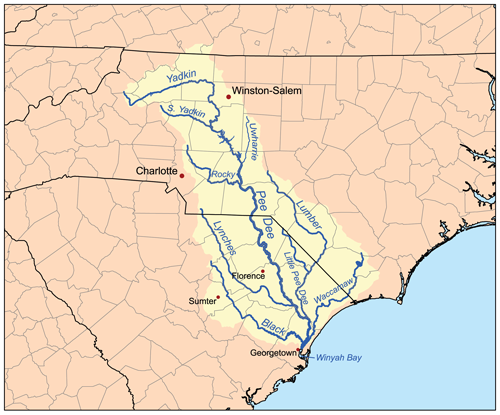
No, not a spelling error. What we know as the great Yadkin River was called "Atkin" by the local Indians. In 1753, following a month of searching through the Carolina backwoods wilderness, Moravian Brother Joseph Spangenberg was directed from the west, by one of his guides, eastward toward the "Atkin River". They missed the path and ended up near current day Blowing Rock. They became lost again realizing they were following the New River. Following months of searching, walking runs which became small creeks then larger creeks ultimately joining the Atkin River near Mulberry Fields (The Current Wilkesboros). The first white people they had seen in weeks told them of large tracks to the east on the three forks of Muddy Creek. It is very likely that they were directed to cross the Atkin at the Shallow Ford. Hence the Atkin's Shallow Ford played a major part in the choice of what would become the 100,000 acre Moravian land of Wachovia in what we now know as Forsyth County the home of our Salem. The Yadkin's Shallow Ford would play a great part in the development of the Wachovia tract. For a most simple river crossing you must travel toward the Shallow Ford.
The Yadkin is one of the longest rivers in North Carolina, becomes the Pee Dee and the confluence of the Uwharrie then flows into South Carolina at the fall line near Cheraw where it becomes the Great Pee Dee River flowing to the Atlantic Ocean.
![]() |
| The Yadkin River - Pilot Mountain in the Background! |
Wednesday, November 17, 2010
Mellow Mushroom - 314 West Fourth
One of the best draws bringing hungry folk to our downtown on a daily basis? Mouth watering
My personal pizza evolution: As a child and young person didn't care for it at all, learned to tolerate it, began to like it, son went to NC State, we shared a Mellow Mushroom House Pizza and I was hooked. It had to have been the best pizza on God's Earth. Mellow Mushroom came to our Salem, I moved nearby - Heaven on Earth! You haven't experienced a pizza if you have failed to experience a Mellow Mushroom pizza. No other pizza even comes close. I try my best to not have more that one a week. It is a difficult task. Even better with one of their awesome salads. The freshest ingredinats and the best crust you will ever put in your mouth.
Don't blame me if you feel the need for one NOW.
![]() |
| Mellow Mushroom House Special Pizza |
My personal pizza evolution: As a child and young person didn't care for it at all, learned to tolerate it, began to like it, son went to NC State, we shared a Mellow Mushroom House Pizza and I was hooked. It had to have been the best pizza on God's Earth. Mellow Mushroom came to our Salem, I moved nearby - Heaven on Earth! You haven't experienced a pizza if you have failed to experience a Mellow Mushroom pizza. No other pizza even comes close. I try my best to not have more that one a week. It is a difficult task. Even better with one of their awesome salads. The freshest ingredinats and the best crust you will ever put in your mouth.Don't blame me if you feel the need for one NOW.
314 West Fourth In the Nissen Building
Subscribe to:
Posts (Atom)


