Showing posts with label Trivia. Show all posts

Monday, December 27, 2010

Something missing from Old Salem?

Ginny Hens Running Loose in Old Salem
My spouse was fascinated at the first sighting of Ginny Hens running free in Old Salem. I believe that this is the only part of town where this is allowed by special decree! Are they an indication of something missing from Old Salem?

Spending a little time in public records you will discover that much is missing from the historically accurate presentation of Salem in the intended time frame. As I walk through the streets of Salem I have been attempting to garner a better understanding of what this place was really like prior to the Civil War. I find this very difficult. The first problem is that much of what was present then is gone. The details are mind boggling! Many buildings, especially farm type buildings, and the surrounding forest are no longer here. The streets are now all paved; there are no more cobblestone, brick, wood, dirt or mud streets. The grade of the streets has also drastically changed over the years to better accommodate travel, drainage and street cars. There are no people in the distance working in their fields. There is no sound of the turning potters wheel or the banging of hammer to anvil. There is no clip, clop, clip, clop of horses hoofs or turning of wood wheels rolling down the streets. What of the swish of long skirts and petticoats or the sound of clean wash blowing in the wind. The smell of straw, hay and manure are gone not to mention the smell of the many privies (a posting coming about that later!). You can walk safely through the streets and yards with no thought for what you might step in next. You can take a deep breath without fear of what you might smell. Do you begin to get the feeling that the historically adequate presentation of Salem based on the era prior to the Civil Was has some serious flaws?

In an attempt to understand and imagine life in pre Civil War Salem I have been conducting a little research and think I may have stumbled on a major missing ingredient to historical accuracy we fail to consider in today's sterile society. Share in my delight following with me studying these public record entries and see if you get the picture.

Care to meet this in the street or your yard?
A book could be written about the trials and tribulations of the Town Commissioners of both Salem and Winston relative to the problem of hogs, cows and other animals running at large within both towns. It is hard to conceive that during these early years, hogs roamed freely over the town streets. This is a public issue beginning in 1772 when Salem is barely starting out and it will remain an issue into the 1900’s.

June 12, 1772 - "There is complaint from the Brethren and Sisters in the town that so many cattle roam the streets that it is dangerous for the children. Answer was made that each should fence in his own yard, and keep the children there or in the house, and not let them run about on the streets."

Are you paying attention? Fence in the yard to keep the children safe from animals freely roaming throughout the town! Don't be concerned about the farm animals, don't let the children run about in the street. How long could this possibly continue? Watch your step or you may be cleaning your shoes!

April 8, 1816 -"For some time it has been customary to let cows that belong in town stand in front of the houses instead of being let immediately into the barnyards. This is disorderly, and bad for the streets, and should be remedied as soon as possible. It would be avoided if the cows were let into the barnyard or stable as soon as they come home."

Did you get it, “come home”, where had they been all day? Where is the historical depiction of the "barnyard or stable" at the homes of Old Salem?

April 22, 1838 -"Complaints were reported about the hogs rambling through the community, about the nightly noise of too many dogs, the bulls and cows in the streets and the great number of doves causing damage in gardens. We wish that all this which harms the love and harmony in the community could be removed."

In the 1850’s Mrs. Webb’s short-tailed cow is reported as a nuisance. The Mayor was directed to inform Mrs. Webb that unless she put up her cow it would be dealt with according to the Ordinance.”

May 26, 1858 The Mayor was requested to notify Mr. Linebach that his cow, because of its vicious habits, not be allowed to run at large.

August 20, 1859- “Ebert was allowed to turn his cow out again-provided he can secure her in such a manner as to prevent her from doing any mischief.” 

June 30, 1873- A petition was received from 53 citizens requested that an ordinance be enacted prohibiting hogs from running at large”…as we are satisfied they are a nuisance to our citizens.” The petition was referred to a committee. By 1874 ordinances were in place to “arrest” hogs running at large. The laws were repealed on January 15, 1875. At the January 25th meeting, a new hog law was enacted.

June 19, 1874- Mayor Vogler suggested to the Board the necessity of building a pound (fenced lot) for hogs and cattle. The Board resolved to build a pound ten feet square and six feet high. It appears that this Pound was used mainly for impounding hogs running at large within the town limits. The charge against the impounded hog was 40 cents for picking up by the Town Constable, and 10 cents per day for feeding each hog weighing over 100 pounds and 5 cents for pigs under 100 pounds. The owner could redeem his property by paying the costs. If not redeemed, these animals were sold at public auction, after notices posted at designated places for ten days.

You would think after the Civil War they might have these issues under control. NOT!

HOGS AND DOGS ORDINANCE

At the November 1, 1895 meeting an ordinance was passed on the keeping of hogs. It stated “No owner or occupant of any Lot within the Town of Salem, with a frontage of not more than 50 feet on any street, shall keep more than two Hogs; with more than 50 feet and less than 100 feet frontage more than four Hogs; and with more frontage than 100 feet more than 6 hogs, and in all cases where it is desired to keep Hogs on lots having no street frontage or on lots have no house thereon, no Hogs shall be kept. In all cases, the Hog pens shall be kept clean and shall be constructed with floors not less than 10 inches above the surface of the ground.”

Multiply these allowed hogs by the number of homes and what is the potential for hogs in town? 

HOG LAW

After several unsuccessful attempts at banning hog lots from Salem, a petition was presented by property owners on Cherry Street calling for an ordinance prohibiting the keeping of hogs in a district bounded by West, First, New Shallowford and Elm St. This was immediately followed by a petition by another group of citizens asking that the law not be changed in that area. At the November 6, 1903 meeting an ordinance was passed favoring the banning of hog keeping in the area. On November 10, two petitions from another section of Salem regarding hog keeping, one for, one against were presented. The Sanitary Committee noted that the majority of property owners in the area actually favored keeping hogs and in this section would not recommend the banning of hog pens.

COW ISSUES

As Salem became more urban, the issue of animals in the back yard became more of a problem. By 1911, hog pens were still allowed in the south east section of the town. There was no general ordinance regarding the keeping of cows or chickens.

June 2, 1911-A petition was received requesting that Mr. Jones cow lot on Poplar St. be declared a nuisance. This was referred to the Sanitary Committee. The Board of Health took up the issue on July 24 with Mr. Jones and his attorney. The questioning takes up two pages of Minutes Books. The lot was 200 ft square and contained 35 or 40 head of cattle. The Board of Health recommended that Jones have until April 1912 to move the lot. April 5, 1912- An Ordinance was approved prohibiting the keeping of more than 4 cows within the corporate limits and making it illegal to operate a dairy within the corporate limits.

THE HOG PROBLEM

One of the first taxes imposed by the Commissioners of Salem in 1857 was a tax on hogs. These animals had to be provided with a collar and tag or some other means of identification to show that the owner had paid this tax.

The minutes of the Salem Board of Commissioners are replete with recordings of complaints and requests made to the Board about the problems created by hogs running at large. There were instances where one group of citizens would present a petition asking that the Board pass an ordinance prohibiting this freedom of the hogs. However, before the Board took action on such a petition, another group of citizens would submit a petition opposing any restrictions on the hogs. In one case, at the request of citizens concerned, the Board prohibited the keeping of hogs within the designated area. However, this was not very effective since the hogs running at large in adjoining territory did not observe this imaginary restricting boundary line.
Hogs ranging in their natural habitat are not necessarily unclean animals, and they become offensive only when confined in close quarters and are forced to wallow in their own filth. They instinctively wallow in mud to get relief from insects, and perhaps they consider this a kind of beauty treatment.

These animals eat most anything with impunity, and are subject to few diseases. When ranging at large they devour almost everything in reach above ground and when this source of food supply is exhausted they root down into the ground in search of further nourishment. These activities can soon devastate the landscape.
The citizens apparently placed a high value on their hogs and they were not very receptive to restrictive town ordinances. The minutes of the Board of Commissioners of Winston, dated August 7, 1868, record: "On motion Section Nineteen of the former ordinance in relation to the taxation of hogs is hereby repealed and the following Ordinance is adopted and ordered to be posted up.

A note follows "See ordinance placed on next page marked Exhibit A." The next page of the minutes indicates that the attached ordinance had been removed. Perhaps this ordinance was later rescinded. The Board minutes of June 21, 1873 records: "On motion the Mayor was directed to confer with the Salem authorities as to the property of a Hog Law, and arranged to act consistently."

It is obvious that as the town expanded and the population density increased, it would be necessary for the town authorities to adopt ordinances and regulations to control the hog problem, just as it became necessary to collect and dispose of night soil from surface privies (another story to tell?) and ultimately to install a sanitary sewerage system.

On June 10, 1876, the Board of Commissioners of Winston adopted this ordinance:
  1. That if any hog or hogs belonging to a citizen of Winston shall be found at large upon the streets of Winston, it shall be the duty of the town officer to have the same taken up and impounded, and after advertising the same for three days at the Court house door, if the owner thereof fail within that time to redeem them by paying a fine of fifty cents for each hog, unless there be more than two hogs belonging to the same owner, and in that case ten cents each over the excess of two, and twenty cents per day for feeding each hog, to sell the same to the highest bidder, and out of the proceeds arising from such sale to pay off all forfeitures, costs and expenses, and pay the overplus to owner on demand; and in case no owner shall redeem within the time specified, nor make application for the said overplus within thirty days after sale, the same shall be forfeited to the use of the corporation.

  2. That each and every hog found rooting up any street or sidewalk of the Town, or otherwise injuring the same, or breaking into any garden or other enclosure, or which shall, in anyway, become troublesome or mischievous, every such hog is hereby declared to be a nuisance, and the owner of every such hog, on notice thereof by the Town Constable, shall immediately remove said hog beyond the Corporate limits of the town, and keep same out of said town, and on the failure thereof shall forfeit and pay one dollar for each day that such person shall suffer said hog to run at large in the town after such notice.
THE SPOTTED SOW PROBLEM RESULTS IN A CALLED MEETING

June 21,1875-"A certain Spotted Sow, four Shoats and four Pigs, said to be the property of Mrs. Fishel, was declared to be a public nuisance, said hogs having been habitually on the public streets and sidewalks of Winston; running at large, rooting and damaging same for more than twenty days. The Town Officer was ordered to notify the said owner that from and after three days the same would be abated.” This was the only business conducted at this meeting.

HITCHING RACKS AND FEEDING TROUGHS

July, 1876-"It is ordered that any person who shall put a hitching rack or other place for hitching stock, every such person shall so provide said rack or hitching place as to prevent any horse or other stock so hitched from getting upon the sidewalk. And no person shall put up any trough upon the street for feeding stock, and each and every person who has heretofore erected any such trough upon the street shall remove the same on five days notice from the Mayor, and no person shall erect any such rack or hitching place on the side of the streets next to and around the Court House Square, and each and every person who shall violate any of the provisions of this ordinance shall for each offense forfeit and pay Twenty Five Dollars."

HOGS TURNED OUT

June 20, 1879-“On motion it was ordered that owners of hogs be allowed to turn them out from this date till the first day of October 1879.”

HOGS IN SALEM

March 6, 1914-“A petition was presented to the board asking that the citizens of the Salem Ward be allowed to keep and raise hogs. The petitioners were informed that the Board had decided not to allow any hogs to be raised in any section of the city.”

On Feb 5, 1915, a similar request was presented “...by colored citizens asking that they be allowed to raise hogs on Columbian Heights. The Board took no action on the petition.”

Do you smell it yet? Lets add some fragrance, fence in Old Salem, leave the cars out and turn the animals loose in the streets and yards! Now, that would be historical accuracy, don't you think?

Wednesday, December 22, 2010

Shell Shaped Gas Station

1111 Sprague Street
Original Construction - 1930
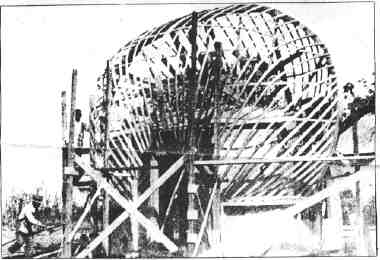
Located at 1111 Sprague Street this shell shaped service station is the last of its kind. Eight were originally built in the late 1930s by the local Quality Oil Company in the shape of a giant scallop shell to attract customers. They are all gone! This station, modeled on the brand logo of Royal Dutch-Shell Oil, was constructed of concrete stucco over a bent wood and wire framework. This building survived through the 1970s and '80s as a lawn mower repair place. It slid into disrepair towards the end of the 20th century.

The building is an example of representational or novelty architecture and was listed on the National Register of Historic Places on 13 May 1976.

Preservation North Carolina, an organization dedicated to the preservation of historic sites, spent one year and $50,000 to bring the landmark station back to its original condition. Workers removed layers of faded yellow paint to reveal the Shell's original yellow-orange color. The original front door was repaired and a crack fixed that had been previously sealed with nothing more than black tar. The wooden, trellised shelter that housed the car wash and allowed cars to be washed and/or serviced in the shade was reconstructed as well. The oil company donated restored gas pumps and replica lamp posts to help finish off the restoration. The landmark now serves as a satellite office for Preservation North Carolina. If you have never seen this, it is well worth the trip!

Tuesday, December 21, 2010

Funny Prayer about Getting Old at the Caregiver of the Year Dinner

If you are dealing with aging parents or aging yourself, you will love this! Hey, not dealing with either, your time is coming so enjoy.


Tuesday, December 14, 2010

First Salem Jail

First Salem Jail
Walking up Main Street in Old Salem north of Winkler Bakery you will visit the A. Butner Hat Shop. Does it look like a Jail to you?

Adam Butner, best know as operator of Salem Tavern, started out as a hatter in a shop constructed in 1825 on Main Street North of Winkler Bakery. Following the incorporation of Salem as a town on March 10, 1857 the new board of commissioners rented the former Adam Butner Hat Shop on Main Street at $30.00 per year to be used as a “Hall and Watch-house.” (This building was reconstructed by Old Salem, Inc. in 1965 and operated as an adjunct to the bakery, before opening as a museum retail store in 2008.) F. Fries was commissioned to build a lock-up in the lower part of this building of 12 feet square of 2 inch oak planks with a good and substantial iron-grated door.

June 23, 1857 – The Board met for the first time in Commissioner’s Hall. Desks, chairs and benches had been purchased and installed and the walls of the building whitewashed.

April 7, 1858 – Since the lockup below the Commissioners Hall was probably the most secure building in Salem, it would have been used for holding slaves as well as criminals. At this meeting the Mayor proposed rules for use of the lockup by slave owners including the amount they were to be charged for feeding and the responsibility for cleaning the lockup when they left.

This building being inadequate, discussion was started almost immediately about building an appropriate building but wasn't addressed for many years.

During the Civil War in 1862 a Mr. Hughes requested to use the Commissioner’s Hall for cutting cloth for soldier’s uniforms. The request was granted. In January 1864, the agreement with Mr. Hughes was rescinded since Hughes was not cleaning up the Hall before the Commissioner’s were supposed to meet.

Former Jail Building as Reconstructed Left of Winkler Bakery

Monday, December 13, 2010

The Reynolda Illusion

Reynolda Estate

If you are a visitor to our Salem, or a resident unfamiliar with the history of the R.J. Reynolds family, it is probable that you share in the Reynolda Illusion. The Illusion is that the historic Reynolda Estates was the fairytale home of local tobacco Baron Richard Joshua Reynolds (1850-1918). Perception and reality are seldom in agreement and often confused by intended or unintended illusion. The story of our wonderful Reynolda Estate is no exception. Please understand that this post is not intended to belittle what Reynolda has become. As a student of the life and times of Richard Joshua Reynolds, and his family, few could possibly enjoy the experience more than I. Although somewhat ignored in earlier years, should you raise question about any of what is addressed in this post it will not be sidestepped by today's informed Reynolda staff. It will also not be addressed in great detail when you inquire or be blatantly placed before your face by staff to adversely affect the illusion.

To begin with Reynolda was not the fairytale dream of Mr. Reynolds, as I understand she chose to call him, but that of his young bride Katharine Smith Reynolds. Mr. Reynolds referred to the land being acquired by his bride as "The Farm". Yes, the complete estate was owned by Katharine Smith Reynolds (1880-1924), it was not held in the name of her renowned husband. He considered it her estate, not his! There was good reason for this in the drastic thirty year difference in their ages and the fact it was her project from start to finish. With exception of providing his vast wealth to fund Katharine's little project he left everything to her. Without doubt Mr. Reynolds knew that there was little chance he would live long enough to gain much pleasure from his brides wonderland and, as it turned out, he was very correct in his judgment.

R.J. Reynolds Home 666 West Fifth Street
Unfortunately, the Reynolds family's life became more of a nightmare at their wonderful Reynolda rather than a fairytale. There life had been somewhat of a fairytale existence during the early years of assembling the land and constructing what would become Reynolda. That existence was at a completely different and little know home located at 666 West Fifth Street. Mr. Reynolds had constructed this home from a mail order design (a popular method at that time) about 1893 (Katharine was a 13 year old living in Mount Airy, NC with her parents). Prior to his marriage he occupied the home with his mother, brother Will and Will's wife Kate. Mrs. Reynolds died shortly before their marriage and Katharine moved into the Fifth Street mansion, Will and Kate moving to a hotel. Four lively children were born and would bring joy to the aging Mr. Reynolds life in this Fifth Street home. During their time together as a family this was their home and fairytale existence, not Reynolda Estate!

You will find the story of Katharine Smith Reynolds and her Reynolda Estate in "A World of Her Own Making" by Catherine Howett. "...with almost unlimited wealth...She envisioned the founding of a model community that would emphasize health, modern technology, mixed-crop scientific farming, education and rural beauty...inspired in part, by the rural landscape of England...The estate eventually expanded to cover more than 1,000 acres." 

The R.J. Reynolds Family
For simplicity and the sake of brevity I will offer the life of Mr. Reynolds and his family in outline form by date and let you decide if my position is correct that Reynolda is an illusion as the home and estate of R.J. Reynolds.

- 1890 - Mr. Reynolds gives his 10 year old cousin Kate Smith, daughter of his mothers sister, a gold bracelet with a joking promise that when she grows up he would marry her.

- In her youth Kate suffers from an aliment, possibly rheumatic fever, leaving her with a chronic heart condition causing issues throughout her life.This condition caused bearing of children to be very dangerous and she experienced ongoing issues with her health throughout her life.

- June 1902 Kate now called Katharine graduates from Sullins College in Bristol, Virginia where interestingly Mr. Reyonlds sister Lucy had attended many years earlier.

- December 1902 it appears that Katharine had entered into a new relationship with her fathers friend and first cousin once removed "Dick" Reynolds. "Dick's" mother and Katharine's mother were sisters. Mr. Reynolds was three years older than her father, five years older than her mother and at 52, thirty years older than she, at twenty two. Mr. Reynolds had already exceeded the average life span of an American man at the turn of the Century.

- Spring 1903 Mr. Reynolds beloved mother, Katharine's aunt dies. She and another young female cousin accompany Mr. Reynolds on a trip to New York. He offers Katharine a job as one of his secretaries in his Winston office. The only female secretary! She accepts and leaves home for Winston within a month.

- October 1904 Katharine is engaged to marry this most desirable, wealthy bachelor and man about town. Mr. Reynolds has a reputation as a sporting man who liked cards, gambling, strong drink, horses and the company of women. 

Katharine Smith Reynolds
- February 1905 they are married in her parents Mount Airy, NC parlor and they leave for an four month, spare no expense, tour of Europe.

- 1906 Shortly following their return to Winston planning begins for starting a "farm" on the outskirts of Winston as she is involved with improvements to the Fifth Street property. The first track of 104 acres is acquired. During the course of this work she would do much traveling and have four children at, the typical for the time, two year intervals. Their first child Richard Joshua "Dick", Jr. is born April 4th 1906. There are later rumors of her health problems.

- August 1908 Daughter Mary is born

- May 1910 Daughter Nancy Susan is born

- 1910 Henrietta van den Berg who the children refer to a "Bum" is hired as live in nurse for the children. "Bum" will become a major influence in all of their lives literally running the household and "The Farm" in Katharine's many business, pleasure and heath related absences. 

- November 1911 son Zachary Smith called "Smith" is born.

- 1911 Kathrine hires Charles Barton Keen to design their "Bungalow" as the Reynolds referred to their new 64 room home. Construction of numerous buildings proceed over the next few years. Drawings would have the name "Mrs. K.S. Reynolds Estate" Not R.J. Reynolds or even Mrs. R.J!

- 1912 Construction of the "Bungalow" begins and takes five years.

- 1917 In the absence of Mr. and Mrs. Reynolds, who were convalescing in different hospitals in the North, she dealing with her heart condition, and he with what would later become known as Pancreatic Cancer, care of the children, completion of the "Bungalow", the move from Fifth Street and decorating their new home for Christmas was supervised by "Bum".

- December 1917 A few days before Christmas the Reynolds return and Mr. Reynolds, with nursing staff moves into a hospital bed in his first floor office of the "Bungalow" arriving from John Hopkins Hospital in Baltimore. Apparently, he was ill enough that dealing with the steps to his second floor bedroom wasn't possible.

- May-June 1918 Mr. Reynolds returned to the hospital in Baltimore until June 20th when he returned by train to Winston and Katharine's beloved Reynolda.

- June 29th 1918 Richard Joshua Reynolds 68 dies at Reynolda. From happy marriage through four children in only 13 years and slightly over six months after they occupied their new home at her Reynolda Estates. His brief time at Reynolda was spent convalescing in a hospital bed in his first floor converted office or in the hospital at Baltimore. It appears he never slept in his new second floor bedroom.

The Scandalous Libby Holman - Something to Remember Her By- Over the next few years Kathrine will marry a younger man, Ed Johnston, in controversy with the Reynolds family who weren't invited to attend the small Reynolda ceremony, spend little time at Reynolda, have a child die in childbirth, and die on May 23, 1924 of an embolism shortly after giving birth to a son. After their mothers death there is much controversy surrounding the stepfather and children. He moves to Baltimore with his son and the family spends very little time at their mothers beloved Reynolda. The new son is never a welcomed part of the Reynolds family and is raised by his father in Baltimore far from Reynolda and the children of R.J. Reynolds. Smith is later involved in a "shot gun" wedding to a textile tycoons daughter which doesn't last long. A daughter is born, he marries renowned torch singer Libby Holman and dies at Reynolda following a gun shot wound to the head on June 5th 1932. There is much world wide controversy over whether a murder by his new wife and/or his best friend or a tragic accident. She and Smith's best friend are prosecuted for his murder. Libby is found to be pregnant and Will Reynolds presses for the charges to be dropped. Smith's son is later killed in a mountain climbing accident at 18 years old.

Does this sound like a Reynolda fairytale to you? I don't think so!

Forsyth County Public Library
What happened to the real 666 West Fifth Street fairytale home of the R.J. Reynolds family?  This site was donated to Forsyth County by Mr. Reynolds son R.J. "Dick" Reynolds, Jr. for use as a county library which now occupies that site. The fairytale home of the Reynolds family is gone and the fairytale transferred to Reynolda Estates where it never existed.

Thursday, November 25, 2010

Thanksgiving Catastrophe - 1892

West End Hotel Zinzendorf
R.J. "Dick" Reynolds
In the chilly dawn, Thanksgiving day 1892, R. J. (Dick) Reynolds left his palatial fifth street home with his shotgun and his entourage hiking through the West End forest surrounding the new Hotel Zinzendorf. They were hunting for their Thanksgiving fowl. Dinner promised a festive affair at the Zinzendorf feasting on the results of their successful adventure. Little could they know, before noon, this day would become one of the foulest days in Salem’s history.

As they walked, pushing back brush, their conversations may have involved the July murder of Ellen Smith. Dick was related to the Smith family of Mount Airy and would later marry Katharine Smith, daughter of his cousin. Ellen, a young mulatto maid at the new hotel, was found in the forest thicket behind the Hotel Zinzendorf with a bullet through her heart. (This would be near where the YWCA’s tennis courts are now located). She was 17 and pregnant. Her convicted murderer, also a hotel employee, was in jail awaiting execution by hanging. This murder would, much later, be moralized in the song “Poor Ellen Smith” by the Kingston Trio.

Additional conversation may have centered on the recent visit to the hotel of Adlai Stevenson, Grove Cleveland’s running mate of the Democratic presidential ticket. Papers all over the country reported the gift to Stevenson of “the left hind foot of a graveyard rabbit, a fetish which is said to invariably bring good luck to the possessor.” Stevenson had recently secured all eleven of North Carolina’s electoral votes and defeated Benjamin Harrison and Whitelaw Reid in the national election. Doubtless due to the lucky rabbits foot!

Hotel Zinzendorf Under Construction
An advertisement in May and June of 1892 in the People’s Press of Salem tempted potential guests with “Pure, bracing air, animating and cheerful surroundings, wholesome food properly prepared and temptingly spread, and sweet downy beds that lull to complete bodily rest.” The ad also promised “elevators, electric lights, hot and cold public and private baths on every floor.” The new electric street cars stopped at the front entrance of the 100 room hotel, now the grandest in North Carolina. The Sauratown range and Pilot Mountain could be viewed as the breeze blew through the upper veranda. The ad further promised “the best ventilated, best drained and arranged … in the South” as well as “the most convenient.”

Historic Map (West End and Hotel Zinzendorf bottom center)
This was the “Gay Nineties” just before the financial panic and stock market crash of 1893. The goal of the Zinzendorf developer was to make the Winston area of Salem “one of the finest resort communities in the country”. The lavish hotel was completed in 1891 on a knoll at the head of Fourth Street (one of the highest elevations in Winston). The hotel was later intended to be surrounded by dramatically curving streets, terraced lawns around lavish homes and parks across the hilly terrain. A drawing was published in the October 9, 1890 People’s Press announcing the coming of “a beautiful large four story structure, with broken roofs, Queen Ann style, fitted and furnished in hardwoods, with every accommodation that can add to the comfort of its guests.” On completion in 1891 the grand, 100 room, four story 300 foot long structure was to have ten towers of various sizes and shapes. In addition to the panoramic view of the mountains, the hotel overlooked a huge forest where many of Salem’s leaders hunted wild game.

In the May 1892 People’s Press added another benefit to the list. “Trotting over the hills…you come to the Marienbad and Mystic Parks springs…Too great stress cannot be laid to the mineral waters. They are most valuable, and are daily effecting remarkable cures…On a single day not less than one hundred vehicles filled with people visited them to drink to new health.”

“It was a crisp autumn day with wind,” one of the hunters would recall years later. “We got some wild turkeys and a large number of quail.” The men brought the birds back to the hotel for perpetration as their evening feast. As guest’s made plans for a carriage ride along the elm lined streets of Belgian block the aroma of freshly baked bread filled the kitchen as cooks prepared vegetables and fruit from nearby farms. Milk arrived from the local dairy farm. Hotel manager, E.S. Boswell from the Manhattan Club in New York was known for presenting food “in the daintiest and most appetizing fashion.”

Anticipating the announcement that “Dinner is served” instead the shout rang from the laundry room of FIRE as flames escaped the rear of the innovative, freshly constructed, wood frame hotel covered in wood shingles and boards. The fire raced through the immense structure as the fire companies raced their teams of horses through the cobbled streets. The smoke intensifying in the distance confirmed that a massive fire was in progress.

Guests and people near rushed through the halls removing furniture and fixtures as they ran. Cadets from nearby Davis Military Academy (now the Methodist Children’s Home) plunged into the burning building to rescue guests and possessions. Strong winds whipped the flames helping them devour the wooden frame and cedar shingles. The People’s Press later reported: “Coming down from the center of the roof, in the shape of a V, was the glowing, seething fire. Then, with wonderful rapidity, the flames sped on with wild, fantastic leaps, and ever increasing heat.”

Hotel Zinzendorf Burning
A cheer rose up from the gathering onlookers as the Salem Fire Company’s highly praised “Rough and Ready” steam pumper, pulled by powerful gray horses, arrived on scene. Unfortunately, their enthusiastic effort was in vain as the pressure at the hotel hydrant on this high hill could not throw the water to adequate height. The heat became so intense that it cracked glass windows two blocks away. The whirling wind sucked up burning cinders, ashes, dust and other debris tossing those hundreds of feet. Large pieces of charred shingles were later discovered four and five miles away.

Ruins of the Hotel Zinzendorf
By 1 PM the grand new hotel lay in ruins as onlookers and firemen feasted on an impromptu “picnic on the grounds,” sharing food salvaged from the magnificent dinner-in-the-making rescued from the flames. They gave thanks that no life or adjacent home was lost to the wind driven flames. Col. William A. Blair, one of the early hunters stated that the feast did not include the turkey and quail they bagged. As he put it: “They were cooked all right, but never served.”

Winston-Salem's Historic West End (NC) (Images of America)Disasters and Heroic Rescues of North Carolina: True Stories of Tragedy and Survival (Disasters Series)The People’s Press summarized the cause and effect of the tragedy: “A building composed of most inflammable material, a gasoline stove, carelessness, no water, and there you go!” The loss was covered by insurance but no one stepped forward to rebuild the glorious Zinzendorf following the failing financial markets of 1893.

Wednesday, November 24, 2010

The Little Red Man

Images of Old Salem: Then & Now
Check Out This Book
Found memories of my childhood are jogged as I often observe school classes touring Old Salem. In the late 50’s and early 60’s, as an elementary school student, part of our curriculum was a special day visiting Old Salem. This was, for most, the first time we were immersed in the daily lives of our ancestors. I recall riding a bus (probably one if not the first time), walking through Salem’s streets, having a bag lunch, touring the Wachovia Museum (at that time in the Boys School building), seeing the stage coach (no longer there), sharing a love feast bun and coffee (probably my first coffee) in the basement kitchen of the Single Brothers House. The memory most entrenched in my mind is the tour guides story of “The Little Red Man”. The reason I remember is that it haunted by mind on sleepless nights and tainted my future visits to Salem with the fear of stumbling into “The Little Red Man”.

Single Brothers House
The tour guide shared with us that “The Little Red Man” was killed in a cave-in accident during the construction of the addition to the Single Brothers House in 1786 and was seen often in the building following his death walking up the very halls and stairs we had just transversed. We were told that if we were to visit at night that we may experience a visit from “The Little Red Man”.

I don’t recall if she shared details of who he was, his accidental death or his hauntings. She probably did, I simply don’t remember. Fortunately, the Moravians are meticulous keepers of records and the details of the untimely death of Andeas Kremser on March 26, 1786 and his haunting of the Single Brothers House are available for consideration. I would learn later in life that The Little Red Man is one of the areas oldest and most enduring ghost stories.

The appearances began following the death of shoe maker Andreas while helping his Brethren excavate the foundation for the basement for a new addition to the “Brothers House”.  The Single Brothers House was a communal home and trade school for unwed boys and men of the Salem area similar to the trade guilds of Europe. As Andreas was working late, around midnight, digging, working on his knees, he was crushed by falling red clay.

Rear Basement Entrance to the Single Brothers House
His brothers quickly dug him out, but his injuries were severe. Although conscious when extracted, he died soon after from his injuries. His time of departure was recorded at 2 AM March 26, 1786. Due to the means of his death and his involvement with the community, Brother Andreas Kresmer’s was much mourned by his Brethren. Apparently, Andreas was somewhat of a prankster. Shortly following his death, the frightening activities began. Strange sounds, noises like that of the tapping of a shoemakers hammer, footsteps in the hall and on the stairs were heard in the night along with a short person in a red cape, resembling the one he was wearing the night he died, was seen scurrying through the halls.

Over the years the large building eventually became a home for Widows. Betsy, deaf from an early childhood illness, knew nothing about the ghost or the accident. While visiting her grandmother Betsy ran excitedly in from the garden telling of a little man in a red cape beckoning her with his finger to come play. Once, two gentlemen were being shown around the house and as they were hearing the story of The Little Red Man they came face to face with the ghost. Agreeing to catch the red caped man they lunged for him only to catch nothing but air with the Little Red Man grinning at them from the door.

Sadly, the little red man hasn’t appeared in the building in recent times. Legend says that he made an ill-advised manifestation before a significant member of the community as he was showing an important visitor around the cellar. A minister visited the building and upon hearing the story claimed to be able to get rid of the ghost. After invoking the holy trinity he spoke the words "Little Red Man, go to rest!" The ghost has not been seen since.

The Little Red Man’s final vanishing act inspired archivist and author Richard Starbuck in his Ghosts of Salem and Other Tales to pose an “open question” to his readers in: “whether one should be grateful to the clergyman who exorcised him, or to the electric lights which have driven the shadows from the sub-cellars of the one time Brothers House.”

You will find this tale in North Carolina Legends by Richard Walser, in Burt Callaway and Jennifer Fitzsimmons Triad Hauntings and Richard Starbuck’s Ghosts of Salem and Other Tales.

Saturday, November 20, 2010

Who Stole Our Aroma?

Has a major change every occurred in your life and you were so busy living that it simply passed you by and one day, like a smack in the face, it suddenly dawned on you that something had drastically changed in your life?

As a small child returning from any trip away from home I didn’t need my eyes open to know we were near home. When you took a deep breath, you couldn’t miss the heavy, rich, syrupy, sweet aroma of tobacco manufacturing permeating the downtown air of our Salem.

This aroma was like the fragrance of a damp humidor, mothers perfume, a new puppy, home, dad’s cologne, thanksgiving dinner, popcorn, Krispy Kreme doughnuts, sugar cake, Moravian chicken pie, peppermint, the strong fragrance of a lover.

One day on the roof of our building gazing around the city at the familiar Reynolds Building surrounded by silent tobacco manufacturing plants, it hit me like the loss of a lover. Something is not right. Something is distinctively different. Then it hit me like a punch to the gut, the aroma is gone. Who stole our aroma?