Showing posts with label History. Show all posts

Sunday, January 2, 2011

Zinzendorf and the Moravians

Excerpt from "Old Salem - The Official Guidebook" by Penelope Niven and Cornelia Wright (click on the link to purchase your copy). Visit the official website of Old Salem Museums and Gardens
"The history of the Moravians comes to life at Old Salem. A unique religious group, the Moravians made the town of Salem an oasis of beauty and order in the Carolina back-country. Today in the workshops, homes, and gardens of Old Salem, men and women carry on the daily tasks of living just as they were done in the late eighteenth and early nineteenth centuries - crafting beautiful objects, running households and businesses, and  engaging in artistic and musical pursuits. This guide will help you make the most of your visit to Old Salem, one of the most authentic living-history museums in the United States."
Zinzendorf and the Moravians

Count Nicholas Ludwig von Zinzendorf
The goals and practices Zinzendorf laid out fit the traditions the Moravians had brought with them to Herrnhut. He recommended that they live out their faith in every aspect of their daily lives, intermingling the secular and the spiritual. They lived by the teachings and text of the Bible, rather than by the rules handed down by the church hierarchy. They patterned their public worship on the scriptures and the Apostolic Church. They believed in service to the church, to the community, and to the world at large.

In all these beliefs the Moravians were strongly influenced by Pietism, a movement that spread across Europe in the late 1600s and strongly influenced the Lutheran Church. In essence, the Pietists believed in a Christianity of experience and participation, a “heart religion” rather than a rigid doctrine and passive acceptance of a formal creed. Zinzendorf saw the Moravian congregation as a branch of Lutheranism, not as a separate church.

On August 13, 1727, in the beautiful refuge of Herrnhut, the pastor John Andrew Rothe gave an address, after which he, Zinzendorf, and the congregation walked to the Lutheran church in Berthelsdorf, a mile away. There the congregation took part in a confirmation and communion service led by Pastor John Suss, at which Zinzendorf offered a prayer. The service so inspired the Brethren that Zinzendorf marked it as the spiritual birthday of the Renewed Moravian Church.

Saturday, January 1, 2011

George Washington Visits Salem - 1791

President George Washington
The following is an excerpt from “About Me” found on this blog:
“My fifth paternal great grandfather was born on December 5th 1733 on land adjacent to the girlhood home of Anna Ball. So what? Anna Ball was the mother of George Washington born on February 22nd 1732. They were the same age and lived near each other! There is documentation that grandfather was particularly acquainted with George Washington as he once lived a neighbor to the General, previous to his turning out under him. Not only him, but most, if not all, of his sons participated in the war which won our freedom. As President, George (its OK to call a friend of your grandfather's by his first name) visited Salem when grandfather lived nearby. Was he there? Did they have a chat? The road back to Virginia would have passed grandfathers home. Did he take a break, water his horses, have lunch or visit for awhile?”
In the spring of 1791 President George Washington began a tour of the southern states, not only to learn first hand about the condition of the country but also to give the citizens of the young United States a chance to meet their first President. His tour of the southern states, as well as visits to other parts of the country, also helped to strengthen the growing sense of American union.

Washington's travels during his presidency were also a testimony to his remarkable physical stamina. In his late fifties at the time of the southern tour, with years of military campaigning behind him, the rigors of travel in America at the end of the eighteenth century had little impact on him. His day often began well before dawn, and Washington would cover as much as fifteen miles before breakfast. In bad weather he traveled in a carriage, but if the day was fine he was in the saddle. Washington must also have felt the stress of being the most popular figure in the country. Wherever he went Washington was lionized. People poured out to see him in cities, towns, and villages all along his itinerary. Meeting and greeting, speeches, dinners and entertainments were all part of the routine. With as many as a dozen toasts at a dinner, Washington either had an amazing head for alcohol or took very small sips.

Washington first traveled south through the eastern parts of the Carolinas and Georgia and then returned to Virginia by a route that took him farther to the west. He entered North Carolina on the return trip late in May near Charlotte. Passing on through the state, Washington intended to spend the night in Salem, and word came to the town to expect the President in the afternoon of May 31st.

It is easy to imagine that Washington's visit to Salem, while it was certainly the occasion of much enthusiasm was also the cause of a bit of anxiety. Throughout the south Washington's tour was a celebration of the Revolution. He was hailed as the Father of his Country. Speeches and toasts memorialized his service in the war against Britain. Many of those who greeted and entertained him had been his fellow soldiers in that war as my Grandfather was. Salem was something of an exception.

The Moravians of Salem and the surrounding countryside - the old tract of Wachovia - had, at the time of the American Revolution, a tradition of pacifism going back more than three hundred years. When hostilities began between the British government and its colonial opponents the Moravians asked to be left alone. The official diary of the Moravian settlements records simply, "It does not accord with our character as Brethren to mix in such political affairs, we are children of peace." To patriots or loyalists, who were sacrificing much for their cause, this was hard to accept. The Moravian settlements were persecuted by both sides as they tried to maintain their religious commitment.

Whatever concern there may have been the meeting between the President and the Moravians went smoothly and pleasantly.

Washington's Southern Tour, May 31, 1791

We are fortunate to have several accounts of Washington's visit to Salem, the most important ones being the diary of the President himself and the official diary of the Moravian community.
President George Washington was at the end of his Southern tour when he arrived at the North Carolina village of Old Salem. His first impression as he approached the Moravian village was how pleasantly it was placed on rising ground surrounded by beautiful meadows, well-cultivated fields, and shady woods. The houses were built in a German style with trees surrounding them forming a pastoral scene.

George Washington
To avoid giving out or owing political favors, Washington declined private offers of food and lodging and always looked for public accommodations wherever possible. He was impressed by the cleanliness and neatness of the Salem Tavern, and as he approached, he was greeted by music from the tavern steps. The Moravian band was an important tradition, but the Moravian practice of not calling attention to or exalting individuals was evident by the absence of festive decorations. Washington rarely smiled because of ill-fitting false teeth, but he wrote in his journal how much he enjoyed his Salem visit.

Major William Jackson, who had political connections in South Carolina, was Washington's private secretary and traveling companion. They were accompanied by Washington's pet greyhound, Cornwallis, and his white parade horse, Prescott. Washington, dressed in his continental uniform, rode Prescott into all the southern towns except Old Salem. In respect of their deep religious convictions, he entered by coach, dressed in civilian clothes, and had Prescott led by a groomsman.

Although smaller than his official state coach, Washington called this traveling coach "his white chariot". The white coach was easily seen and recognizable from a great distance. The oval presidential seal, designed by Washington and used today, was painted on each of the four quarter panels. The four seasons, by Italian artist Cypriani, were painted on the doors, front and back of the coach. Washington would have preferred six cream-colored horses with white manes, but was warned that they would be a great disadvantage in the red dirt he would encounter on his southern journey. Instead he chose four reddish-brown, black-manned bays.

Great crowds followed and gathered around the entourage to see the legendary commander. While the men dressed as all 18th century males, the Moravian ladies stood out in the crowds by their unique dress. Work dresses were solid blue or brown, and a cap that covered all signs of hair was worn indoors and out. The caps and better dresses were always white. The ribbons that tied the cap and laced the jacket of the dress were colored according to the status of the woman. Little girls wore bright red, single women wore pink, married women blue, and widows wore white.

Charles Caldwell, one of the thirteen-rider escorts formed in Salisbury, is the standard-bearer on a white horse. The thirteen riders represented the thirteen colonies. Caldwell and his company met Washington at Waxaws to guide and inform him of the land, the people, and historic events of North Carolina. They traveled with him to the border of Virginia as Washington returned to his home at Mount Vernon.

Washington was impressed with the neat orderly appearance of the town as well as with the demeanor of its inhabitants. He considered it a well governed, hard-working community. The people of Salem were impressed with Washington's simple, friendly manner, particularly with children. The Moravians loved music, and Washington was so pleased with the band which played for him on his arrival that he asked if he could have music to accompany his dinner. The next day, June 1, Washington toured Salem, visiting its workshops and Choir houses. He was particularly taken with the waterworks. In the afternoon the leaders of the community made a formal address to the President to which he responded. Governor Alexander Martin arrived late in the afternoon, and he and the President attended a "singstunde" with singing and instrumental music. At four o'clock on the morning of June 2nd, the presidential party left Salem and on June 9 crossed back into Virginia.

Many places claim that George Washington slept there, but few have documentation to support such a visit. Salem not only has such documentation, but President Washington provided documentation himself of his visit to Salem, NC beginning on May 31st 1791 as part of his Southern tour in the Diary of his tour through North Carolina.

"Salem is a small but neat village, and like all the rest of the Moravian settlements, is governed by an excellent police, having within itself all kind of artisans. The number of souls does not exceed 200. Wednesday, June 1st, having received information that Gov Martin was on his way to meet me, and would be at Salem this evening, I resolved to await his arrival at this place, instead of halting a day at Guilford as I had intended. Spent the foeehoen (afternoon?) in visiting the shops of the different tradesmen; the houses of accommodation for the single men and sisters of the fraternity, and their place of worship. Invited six of their principal men to dine with me, and in the evening went to hear them sing, and perform on a variety of instruments, church music."

This is a compilation of the visit:
...was visited by the first President of the United States, George Washington, then on a visit to Alexander Martin, Governor of North Carolina. General Washington spent a day among the Moravians, visiting the homes of the single brethren and single sisters, and in the evening attending service in the church. The President seemed to take an a special interest in the water works by which the town was supplied with water. In the Reich homestead, now occupied by Mr. Augustus Reich, a descendant of the family who occupied it in 1791, is the room where the meeting took place between Washington and the town authorities. The conversation was carried on in the French language. The room is much the same as in the olden times. In an adjoining room a young girl, (afterwards the late Mrs. Isaac Boner) played on a spinet, the piano of those days. Washington heard the music and entered, listened to her and highly commended her work. The lodging room of the President in the old hotel is shown in good state of preservation, and in appearance is the same as when occupied by him. The building is of brick and in the old German style of architecture. It stands among the few "Washington headquarters" in the South, and should be preserved as such.  
Washington: A Life
Check out this Book!
On June 1st, 1791 a large number of people came to the tavern to see and greet President Washington, who came out and mingled with them, saying in response to their hearty cheers: "after all, good people, I am but a citizen of our free country, like you all. I thank you for the honor shown me." Turning around be saw a group of boys, and laying his hands on each of their heads as he passed along, he gave them a few encouraging words. Next day, June 2, in company with Governor Martin, the President went to the Governor's home in Rockingham county, a few miles above Leaksville (now Eden).

Friday, December 31, 2010

What Did They Find Here?

When those Scots Irish and Germans got here "the country of the upper Yadkin teemed with game. Bears were so numerous it was said that a hunter could lay by two or three thousand pounds of bear grease in a season. The tale was told in the forks that nearby Bear Creek took its name from the season Daniel Boone killed 99 bears along its waters. The deer were so plentiful that an ordinary hunter could kill four or five a day; the deerskin trade was an important part of the regional economy. In 1753 more than 30,000 skins were exported from North Carolina, and thousands were used within the colony for the manufacture of leggings, breeches and moccasins." In 1755, NC Gov. Arthur Dobbs wrote to England that the "Yadkin is a large beautiful river. Where there is a ferry it is nearly 300 yards over it, [which] was at this time fordable, scarce coming to the horse's bellies." At six miles distant, he said, "I arrived at Salisbury the county seat of Rowan.
Danial Boone about 1760
The town is just laid out, the courthouse built, and 7 or 8 log houses built." Most of Salisbury's householders ran public houses, letting travelers sup at their table and drink too. In 1762, there were 16 public houses. There was also a shoe factory, a prison, a hospital and armory all here before the Revolution. Even so, it was still only an outpost in the wilderness. Salisbury was for twenty-three years the farthest west county seat in the colonies. And through this outpost the wagon road ran, and on that road the immigrants continued to travel even after the area was settled. Governor Tryon wrote to England that more than a thousand wagons passed through Salisbury in the Fall and Winter of 1765. That works out to about six immigrant wagons per day. This river area now is part of High Rock Lake.

Modified from the article: The Scots-Irish From Ulster and The Great Philadelphia Wagon Road
Information provided by Brenda E.McPherson Compton

Thursday, December 30, 2010

Who Traveled South on the Wagon Road?

For 118 years, the English and Dutch settled the New World, lining the harbors and pointing their cities, their eyes, their hearts to the east, across the Atlantic. They were on the fringes of a vast continent but, for the most part, they forever more turned away from it and toward home. They were certainly colonists, even those stern faced few who came to these shores for religious reasons. Most of the other settlers had come to expand the business opportunities of home establishments. Their ties to those establishments were strong.

Chasing The Frontier: Scots-Irish in Early AmericaIt took a different kind of settler, someone who had cut his ties altogether, someone who didn't really have all that much to lose, to look west at a wilderness and there see something more than raw materials ready for exploitation. It took folks like the Germans and the Scots Irish to put their backs to the ocean and see home in front of them. Escaping devastating wars, religious persecution, economic disasters, and all of those other things that still cause people to come to these shores, the Scots Irish and the Germans had no intention of returning to their native lands. They were here to stay. They didn't look east but to the south and west toward land. They didn't see wolves and Indians. They saw opportunities. And as different as the Germans and the Scots Irish were, they had what it took to flourish in the back country. Not possessions that could be lost in the fording of a river, not personal contacts and the sponsorship of powerful men, but rough and tumble ability and a heavy streak of stubbornness. They knew slash and agriculture, they knew pigs, they could hunt and forage, they knew hard work. They built their cabins the exact same way. And eventually, they traveled together in that same heavy stream southward along The Great Pennsylvania Wagon Road.

The Great Wagon Road: From Philadelphia to the SouthIn 1749, 12,000 Germans reached Pennsylvania. By 1775, there were 110,000 people of German birth in that colony, one-third of the population. When Philadelphia was a cluster of Inns and Ordinaries: the Blue Anchor, Pewter Platter, Penny Pot, Seven Stars, Cross Keys, Hornet and Peacock. Benjamin Franklin, one of that era's most open-minded men asked, "Why should the Palatinate Boors be suffered to swan-n into our settlement and by herding together establish their language and manners to the exclusion of ours? Why should Pennsylvania, founded by the English, become a colony of aliens who will shortly be so numerous as to Germanize us, instead of our Anglicizing them and will never adopt our language or customs any more than they can acquire our complexion."  But the Germans kept coming, thinking like their Scots Irish compatriots who are recorded as noting that!, "It was against the law of God and nature that so much land should be idle while so many Christians wanted it to labor on and raise their bread."   In short, Pennsylvania was flooded.

Modified from the article: The Scots-Irish From Ulster and The Great Philadelphia Wagon Road
Information provided by Brenda E.McPherson Compton

Wednesday, December 29, 2010

Why Did They Travel South?

There is probably no more beautiful land anywhere than that part of Pennsylvania now known as the "Amish Country." It must have appeared to those people fresh off of the boat, truly a land flowing with milk and honey. But it filled rapidly. Land became expensive. The most important reason why the Germans and Scots-Irish put what little they owned on their backs and took the southbound road was the cost of land in Pennsylvania. A fifty acre farm in Lancaster County, PA would have cost 7 pounds 10 shillings in 1750. In the Granville District of North Carolina, which comprised the upper half of the state, five shillings would buy 100 acres.  The crossing of an ocean was move enough for most of the early immigrants. The generation, which could still feel the waves beneath their feet when elderly, often stayed in Pennsylvania, but their children repeated their parent's adventure. Often, they cast off their lines, raised whatever anchors they had, and "sailed" south right after their patriarchs had gone to their reward.

The War That Made America: A Short History of the French and Indian WarAs North Carolina's Secretary of State, William L. Saunders wrote in 1886,   "Immigration, in the early days, divested of its glamor and brought down to solid fact, is the history of a continuous search for good bottom land."  In their search for bottom land, English colonists encroached onto territories claimed by France. This pressure became one of the reasons the French and Indians went to war against England and her colonists. The Germans and Scots bore the brunt of the war, a cabin burning, wife-kidnapping, farm ambushing, bloody, and horrible guerrilla war. For eleven years mayhem reigned on the frontier. In 1756, three years after the war started, George Washington wrote that the Appalachian frontiersmen were "in a general motion towards the southern colonies" and that Virginia's westernmost counties would soon be emptied. Western North Carolina seemed to those escaping the war to be safer because the Cherokee were on the British side-at least at the beginning. To western North Carolina they came.  This French and Indian War, which started the year Rowan County was created, joined the quest for more and better land as a major factor in sending those Germans and Scots-Irish down the Wagon Road to safer territory. Not only that but, the peace treaty that ended the war stated that no English settlers would go over the Appalachians. Thus, the best unclaimed land in all of the colonies lay along the Yadkin, Catawba and Savannah Rivers between the years 1763 and 1768.  When the war ended in 1764, the western settlements of Pennsylvania had suffered a loss of population. Virginia and North Carolina had grown.

Modified from the article: The Scots-Irish From Ulster and The Great Philadelphia Wagon Road
Information provided by Brenda E.McPherson Compton

Tuesday, December 28, 2010

The Great Philadelphia Wagon Road

October 1753, fifteen Moravians are traveling to North Carolina to begin a new settlement. The route they follow from Pennsylvania does not yet have its famous name: The Great Philadelphia Wagon Road. The brothers often were required to cut down trees, improve and widen the road in order to pass.

During the early years, travelers walked, leading five or six pack animals laden with supplies: tools, seed, and fabric. In places, the famous path they trod was only three or four feet wide. The wilderness literally crept right up to their feet and brushed their faces as they walked. In later years they marched alongside oxen as these over sized beast pulled two-wheeled carts heaped to overflowing, crossing rivers that licked high about their animals flanks and often soaked every single individual piece of their worldly possessions. Finally, when the path had been worn clear by thousands and thousands of previous travelers, they rode in wagons as the path was widened into an honest to goodness road. These Pennsylvania German built wagons at their largest would be twenty-six feet long, eleven feet high and some could bear loads up to ten tons. It took five or six pairs of horses to pull them.


No matter if they walked or rode, in the mid afternoon, they stopped to take care of the animals, prepare food, and put up the defense for the night. The cries of wolves in the distance and the pop of twigs just outside of the firelight sounded danger. Bands of Indians in the early days, bands of thieves later, chased away deep sleep, no matter how tiring the day, how bone weary the traveler. The fastest loaded wagon could go about five miles a day. The trip took a minimum of two months. Wagons broke down, rivers flooded, supplies gave out, and there was sickness but no doctors. Wagons were repaired, floods ceded, the wilderness supplied their need, and the sick were buried or stumbled on.

Only a few trails cut through the vast forests, which covered the continent between the northernmost colonies and Georgia, the southern tip. The settlers, as they moved inland, usually followed the paths over which the Indians had hunted and traded. The Indians, in turn, had followed the prehistorical traces of animals. Who knows why the animals wandered where they did, but some of those early travelers on that road, the Scots-Irish Presbyterians, would have assured us it was certainly predetermined. Even so, few paths crossed the Appalachians, which formed a barrier between the Atlantic plateau and the unknown interior. Through this unknown, even then, there was a road. The Iroquois tribesmen of the North had long used the great warriors path to come south and trade or make war in Virginia and the Carolinas. This vital link between the native peoples led from the Iroquois Confederacy around the Great Lakes through what later became Lancaster and Bethlehem, Pa. through York to Gettysburg and into Western Maryland around what is now Hagerstown. It crossed the Potomac River at Evan Watkins Ferry, followed the narrow path across the back country to Winchester, through the Shenandoah Valley of Virginia to Harrisonburg, Staunton, Lexington, and Roanoke. On it went into Salem, NC, and on to Salisbury, where it was joined by the east-west Catawba and Cherokee Indian Trading Path at the Trading Ford across the Yadkin River. On to Charlotte and Rock Hill, SC where it branched to take two routes, one to Augusta and another to Savannah, Georgia. It was just a narrow line through the continuous forest.

Virginia's Gov. Col. Alexander Spotswood first discovered this Great Road in 1716 when his "Knights of the Golden Horseshoe," crossed the mountains, drank a toast to King George's health and buried a bottle claiming the vast valley for the King of England. In 1744, a treaty between the English colonists and the Indians gave the white men control of the road for the first time. By 1765 the Great Wagon Road was cleared enough to hold horse drawn vehicles and by 1775, the road stretched 700 miles. Boys and dogs, smelling like barnyards, drove tens of thousands of pigs to market along this road, which grew gradually worse the farther South you went. Inns and ordinaries, which spotted the road undoubtedly taught more than a few of them the ways of the world. But that was all later.

The majority of the folks who by the thousands would walk over Spotswood's buried bottle would have probably thought his whole 1716 ceremony a little preposterous and quite a bit pretentious. You see, they were plain folk trying to get away from Latin, from mottoes, and from knights with horseshoes no matter their element of manufacture, steel or gold. They were as different from Spotswood's cavaliers as a golden horseshoe is from an ox's hoof.

In the last sixteen years of the colonial era," wrote historian Carl Bridenbaugh, "Southbound traffic along The Great Philadelphia Wagon Road was numbered in tens of thousands. It was the most heavily traveled road in all America and must have had more vehicles jolting along its rough and tortuous way than all the other main roads put together."

When the British captured Philadelphia, the Continental Congress escaped down The Pennsylvania Wagon Road. Daniel Boone and Davy Crockett traveled it. George Washington knew it as an Indian fighter. John Chisholm knew it as an Indian trader. Countless soldiers, Andrew Jackson, Andrew Pickens, Andrew Lewis, Francis Marion, Lighthorse Harry Lee, Daniel Morgan, and George Rogers Clark, among them, fought over it. Both the North and South would use it during the Civil War.

The Great Wagon Road: From Philadelphia to the SouthAnd down this road, this glorified overgrown footpath through the middle of nowhere leading to even greater depths of nowhere, came those people looking for a better life for themselves and their children, down it came those settlers, those hardworking stubborn Scots Irish and Germans: the preachers, the blacksmiths, and farmers.


Modified from the article: The Scots-Irish From Ulster and The Great Philadelphia Wagon Road
Information provided by Brenda E.McPherson Compton

First Map of the Wagon Road:

1751 Map by by Joshua Fry and Peter Jefferson
 The 1751 map by Joshua Fry and Peter Jefferson (Thomas Jefferson's father) is in the collection of the Moravian Archives and is one of the many early treasures housed in Salem.This blogger is privileged to have a copy made directly from this map in his collection.

The map above, drawn by Joshua Fry and Peter Jefferson (Thomas Jefferson’s father) in 1751, was the first to show “The Great Road from the Yadkin River thru Virginia to Philadelphia distant 455 Miles” — what would come to be known as The Great Philadelphia Wagon Road or just the Great Wagon Road. Fry and Jefferson based their map on firsthand surveys not, as was common at the time, on the word of other people who had traveled through the land. On their map, the road ends at Wachovia (Wachaw), the Moravian settlement. Later, it would be extended further south and west. Also marked is the “Trading Path leading to the Catawba & Cherokee Indian Nations,” the Indian trading path that predated European settlement.

Fry and Jefferson were commissioned to draw an accurate map of the most-inhabited (by whites, that is) parts of Virginia, and that was the only land they surveyed. As a result, they drew the border between Virginia and North Carolina only as far west as the Allegheny Mountains, although in theory that border still ran to the Pacific Ocean. Note that the western border of Pennsylvania is clearly drawn on the map; Virginia also claimed all the land that is now Ohio. Note also that the boundary between Maryland and Pennsylvania isn’t drawn! That boundary was in dispute at the time. Not until 1763 would Mason and Dixon set out from Philadelphia to survey the boundary between the two colonies and draw the line that would bear their names.

Monday, December 27, 2010

Something missing from Old Salem?

Ginny Hens Running Loose in Old Salem
My spouse was fascinated at the first sighting of Ginny Hens running free in Old Salem. I believe that this is the only part of town where this is allowed by special decree! Are they an indication of something missing from Old Salem?

Spending a little time in public records you will discover that much is missing from the historically accurate presentation of Salem in the intended time frame. As I walk through the streets of Salem I have been attempting to garner a better understanding of what this place was really like prior to the Civil War. I find this very difficult. The first problem is that much of what was present then is gone. The details are mind boggling! Many buildings, especially farm type buildings, and the surrounding forest are no longer here. The streets are now all paved; there are no more cobblestone, brick, wood, dirt or mud streets. The grade of the streets has also drastically changed over the years to better accommodate travel, drainage and street cars. There are no people in the distance working in their fields. There is no sound of the turning potters wheel or the banging of hammer to anvil. There is no clip, clop, clip, clop of horses hoofs or turning of wood wheels rolling down the streets. What of the swish of long skirts and petticoats or the sound of clean wash blowing in the wind. The smell of straw, hay and manure are gone not to mention the smell of the many privies (a posting coming about that later!). You can walk safely through the streets and yards with no thought for what you might step in next. You can take a deep breath without fear of what you might smell. Do you begin to get the feeling that the historically adequate presentation of Salem based on the era prior to the Civil Was has some serious flaws?

In an attempt to understand and imagine life in pre Civil War Salem I have been conducting a little research and think I may have stumbled on a major missing ingredient to historical accuracy we fail to consider in today's sterile society. Share in my delight following with me studying these public record entries and see if you get the picture.

Care to meet this in the street or your yard?
A book could be written about the trials and tribulations of the Town Commissioners of both Salem and Winston relative to the problem of hogs, cows and other animals running at large within both towns. It is hard to conceive that during these early years, hogs roamed freely over the town streets. This is a public issue beginning in 1772 when Salem is barely starting out and it will remain an issue into the 1900’s.

June 12, 1772 - "There is complaint from the Brethren and Sisters in the town that so many cattle roam the streets that it is dangerous for the children. Answer was made that each should fence in his own yard, and keep the children there or in the house, and not let them run about on the streets."

Are you paying attention? Fence in the yard to keep the children safe from animals freely roaming throughout the town! Don't be concerned about the farm animals, don't let the children run about in the street. How long could this possibly continue? Watch your step or you may be cleaning your shoes!

April 8, 1816 -"For some time it has been customary to let cows that belong in town stand in front of the houses instead of being let immediately into the barnyards. This is disorderly, and bad for the streets, and should be remedied as soon as possible. It would be avoided if the cows were let into the barnyard or stable as soon as they come home."

Did you get it, “come home”, where had they been all day? Where is the historical depiction of the "barnyard or stable" at the homes of Old Salem?

April 22, 1838 -"Complaints were reported about the hogs rambling through the community, about the nightly noise of too many dogs, the bulls and cows in the streets and the great number of doves causing damage in gardens. We wish that all this which harms the love and harmony in the community could be removed."

In the 1850’s Mrs. Webb’s short-tailed cow is reported as a nuisance. The Mayor was directed to inform Mrs. Webb that unless she put up her cow it would be dealt with according to the Ordinance.”

May 26, 1858 The Mayor was requested to notify Mr. Linebach that his cow, because of its vicious habits, not be allowed to run at large.

August 20, 1859- “Ebert was allowed to turn his cow out again-provided he can secure her in such a manner as to prevent her from doing any mischief.” 

June 30, 1873- A petition was received from 53 citizens requested that an ordinance be enacted prohibiting hogs from running at large”…as we are satisfied they are a nuisance to our citizens.” The petition was referred to a committee. By 1874 ordinances were in place to “arrest” hogs running at large. The laws were repealed on January 15, 1875. At the January 25th meeting, a new hog law was enacted.

June 19, 1874- Mayor Vogler suggested to the Board the necessity of building a pound (fenced lot) for hogs and cattle. The Board resolved to build a pound ten feet square and six feet high. It appears that this Pound was used mainly for impounding hogs running at large within the town limits. The charge against the impounded hog was 40 cents for picking up by the Town Constable, and 10 cents per day for feeding each hog weighing over 100 pounds and 5 cents for pigs under 100 pounds. The owner could redeem his property by paying the costs. If not redeemed, these animals were sold at public auction, after notices posted at designated places for ten days.

You would think after the Civil War they might have these issues under control. NOT!

HOGS AND DOGS ORDINANCE

At the November 1, 1895 meeting an ordinance was passed on the keeping of hogs. It stated “No owner or occupant of any Lot within the Town of Salem, with a frontage of not more than 50 feet on any street, shall keep more than two Hogs; with more than 50 feet and less than 100 feet frontage more than four Hogs; and with more frontage than 100 feet more than 6 hogs, and in all cases where it is desired to keep Hogs on lots having no street frontage or on lots have no house thereon, no Hogs shall be kept. In all cases, the Hog pens shall be kept clean and shall be constructed with floors not less than 10 inches above the surface of the ground.”

Multiply these allowed hogs by the number of homes and what is the potential for hogs in town? 

HOG LAW

After several unsuccessful attempts at banning hog lots from Salem, a petition was presented by property owners on Cherry Street calling for an ordinance prohibiting the keeping of hogs in a district bounded by West, First, New Shallowford and Elm St. This was immediately followed by a petition by another group of citizens asking that the law not be changed in that area. At the November 6, 1903 meeting an ordinance was passed favoring the banning of hog keeping in the area. On November 10, two petitions from another section of Salem regarding hog keeping, one for, one against were presented. The Sanitary Committee noted that the majority of property owners in the area actually favored keeping hogs and in this section would not recommend the banning of hog pens.

COW ISSUES

As Salem became more urban, the issue of animals in the back yard became more of a problem. By 1911, hog pens were still allowed in the south east section of the town. There was no general ordinance regarding the keeping of cows or chickens.

June 2, 1911-A petition was received requesting that Mr. Jones cow lot on Poplar St. be declared a nuisance. This was referred to the Sanitary Committee. The Board of Health took up the issue on July 24 with Mr. Jones and his attorney. The questioning takes up two pages of Minutes Books. The lot was 200 ft square and contained 35 or 40 head of cattle. The Board of Health recommended that Jones have until April 1912 to move the lot. April 5, 1912- An Ordinance was approved prohibiting the keeping of more than 4 cows within the corporate limits and making it illegal to operate a dairy within the corporate limits.

THE HOG PROBLEM

One of the first taxes imposed by the Commissioners of Salem in 1857 was a tax on hogs. These animals had to be provided with a collar and tag or some other means of identification to show that the owner had paid this tax.

The minutes of the Salem Board of Commissioners are replete with recordings of complaints and requests made to the Board about the problems created by hogs running at large. There were instances where one group of citizens would present a petition asking that the Board pass an ordinance prohibiting this freedom of the hogs. However, before the Board took action on such a petition, another group of citizens would submit a petition opposing any restrictions on the hogs. In one case, at the request of citizens concerned, the Board prohibited the keeping of hogs within the designated area. However, this was not very effective since the hogs running at large in adjoining territory did not observe this imaginary restricting boundary line.
Hogs ranging in their natural habitat are not necessarily unclean animals, and they become offensive only when confined in close quarters and are forced to wallow in their own filth. They instinctively wallow in mud to get relief from insects, and perhaps they consider this a kind of beauty treatment.

These animals eat most anything with impunity, and are subject to few diseases. When ranging at large they devour almost everything in reach above ground and when this source of food supply is exhausted they root down into the ground in search of further nourishment. These activities can soon devastate the landscape.
The citizens apparently placed a high value on their hogs and they were not very receptive to restrictive town ordinances. The minutes of the Board of Commissioners of Winston, dated August 7, 1868, record: "On motion Section Nineteen of the former ordinance in relation to the taxation of hogs is hereby repealed and the following Ordinance is adopted and ordered to be posted up.

A note follows "See ordinance placed on next page marked Exhibit A." The next page of the minutes indicates that the attached ordinance had been removed. Perhaps this ordinance was later rescinded. The Board minutes of June 21, 1873 records: "On motion the Mayor was directed to confer with the Salem authorities as to the property of a Hog Law, and arranged to act consistently."

It is obvious that as the town expanded and the population density increased, it would be necessary for the town authorities to adopt ordinances and regulations to control the hog problem, just as it became necessary to collect and dispose of night soil from surface privies (another story to tell?) and ultimately to install a sanitary sewerage system.

On June 10, 1876, the Board of Commissioners of Winston adopted this ordinance:
  1. That if any hog or hogs belonging to a citizen of Winston shall be found at large upon the streets of Winston, it shall be the duty of the town officer to have the same taken up and impounded, and after advertising the same for three days at the Court house door, if the owner thereof fail within that time to redeem them by paying a fine of fifty cents for each hog, unless there be more than two hogs belonging to the same owner, and in that case ten cents each over the excess of two, and twenty cents per day for feeding each hog, to sell the same to the highest bidder, and out of the proceeds arising from such sale to pay off all forfeitures, costs and expenses, and pay the overplus to owner on demand; and in case no owner shall redeem within the time specified, nor make application for the said overplus within thirty days after sale, the same shall be forfeited to the use of the corporation.

  2. That each and every hog found rooting up any street or sidewalk of the Town, or otherwise injuring the same, or breaking into any garden or other enclosure, or which shall, in anyway, become troublesome or mischievous, every such hog is hereby declared to be a nuisance, and the owner of every such hog, on notice thereof by the Town Constable, shall immediately remove said hog beyond the Corporate limits of the town, and keep same out of said town, and on the failure thereof shall forfeit and pay one dollar for each day that such person shall suffer said hog to run at large in the town after such notice.
THE SPOTTED SOW PROBLEM RESULTS IN A CALLED MEETING

June 21,1875-"A certain Spotted Sow, four Shoats and four Pigs, said to be the property of Mrs. Fishel, was declared to be a public nuisance, said hogs having been habitually on the public streets and sidewalks of Winston; running at large, rooting and damaging same for more than twenty days. The Town Officer was ordered to notify the said owner that from and after three days the same would be abated.” This was the only business conducted at this meeting.

HITCHING RACKS AND FEEDING TROUGHS

July, 1876-"It is ordered that any person who shall put a hitching rack or other place for hitching stock, every such person shall so provide said rack or hitching place as to prevent any horse or other stock so hitched from getting upon the sidewalk. And no person shall put up any trough upon the street for feeding stock, and each and every person who has heretofore erected any such trough upon the street shall remove the same on five days notice from the Mayor, and no person shall erect any such rack or hitching place on the side of the streets next to and around the Court House Square, and each and every person who shall violate any of the provisions of this ordinance shall for each offense forfeit and pay Twenty Five Dollars."

HOGS TURNED OUT

June 20, 1879-“On motion it was ordered that owners of hogs be allowed to turn them out from this date till the first day of October 1879.”

HOGS IN SALEM

March 6, 1914-“A petition was presented to the board asking that the citizens of the Salem Ward be allowed to keep and raise hogs. The petitioners were informed that the Board had decided not to allow any hogs to be raised in any section of the city.”

On Feb 5, 1915, a similar request was presented “...by colored citizens asking that they be allowed to raise hogs on Columbian Heights. The Board took no action on the petition.”

Do you smell it yet? Lets add some fragrance, fence in Old Salem, leave the cars out and turn the animals loose in the streets and yards! Now, that would be historical accuracy, don't you think?

Sunday, December 26, 2010

History and Faith of the Moravians – The Faith Reborn at Herrnhut

Excerpt from "Old Salem - The Official Guidebook" by Penelope Niven and Cornelia Wright (click on the link to purchase your copy). Visit the official website of Old Salem Museums and Gardens
"The history of the Moravians comes to life at Old Salem. A unique religious group, the Moravians made the town of Salem an oasis of beauty and order in the Carolina back-country. Today in the workshops, homes, and gardens of Old Salem, men and women carry on the daily tasks of living just as they were done in the late eighteenth and early nineteenth centuries - crafting beautiful objects, running households and businesses, and  engaging in artistic and musical pursuits. This guide will help you make the most of your visit to Old Salem, one of the most authentic living-history museums in the United States."

The Faith Reborn at Herrnhut

For decades the church survived in small, hidden enclaves in Bohemia, Moravia, and Poland. In 1772 in Dresden, Christian David, a carpenter and a member of the Unity of the Brethren, met Count Nicholas Ludwig von Zinzendorf. During their conversations about religion, David told the count about how its members yearned to practice their faith in the light of day. Zinzendorf offered to let a few families settle near his estate at Berthelsdorf, in the German state of Saxony.

Led by Christian David, a small company of Brethren slipped out of Moravia in May 1722. They traveled through Bohemia to Saxony to take sanctuary near Zinzendorf’s vast estate. In this refuge, the Moravians gathered strength and built a carefully organized communal town called Herrnhut, a word with two meanings: “under the Lord’s watch” and “on watch for the Lord.”

Zinzendorf preaching to people from many nations
A few at a time, other Moravian men, women and children made their way to Herrnhut, evading their enemies, often crossing unfriendly borders by night. By May 1725 there were ninety Moravians in the Herrnhut community. Other religious refugees also found safety there – Lutherans, Calvinists, Anabaptists, Separatists, and former Catholics. Gradually Count Zinzendorf assumed the role of minister, counselor, and sometimes mediator in this ecumenical flock.

With the Herrnhutter’s varied backgrounds and ideas about how their community should be run, dissension was inevitable. To quell the arguments that were splitting the community, Zinzendorf devised a plan to foster harmony, outlining it in the carefully crafted Brotherly Agreement of the Brethren from Bohemia and Moravia and Others, Binding Them to Walk According to the Apostolic Rule. This document, which contains many principles of the old Unitas Fratrum, became the foundation for all future Moravian congregation towns, including Salem. It reflected Zinzendorf’s long-held belief in being kind to all people, being true to Christ, and carrying the gospel to nonbelievers or the “heathen,” as Zinzendorf put it.

Wednesday, December 22, 2010

Shell Shaped Gas Station

1111 Sprague Street
Original Construction - 1930
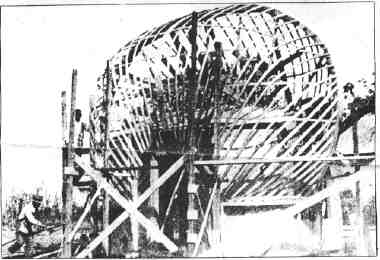
Located at 1111 Sprague Street this shell shaped service station is the last of its kind. Eight were originally built in the late 1930s by the local Quality Oil Company in the shape of a giant scallop shell to attract customers. They are all gone! This station, modeled on the brand logo of Royal Dutch-Shell Oil, was constructed of concrete stucco over a bent wood and wire framework. This building survived through the 1970s and '80s as a lawn mower repair place. It slid into disrepair towards the end of the 20th century.

The building is an example of representational or novelty architecture and was listed on the National Register of Historic Places on 13 May 1976.

Preservation North Carolina, an organization dedicated to the preservation of historic sites, spent one year and $50,000 to bring the landmark station back to its original condition. Workers removed layers of faded yellow paint to reveal the Shell's original yellow-orange color. The original front door was repaired and a crack fixed that had been previously sealed with nothing more than black tar. The wooden, trellised shelter that housed the car wash and allowed cars to be washed and/or serviced in the shade was reconstructed as well. The oil company donated restored gas pumps and replica lamp posts to help finish off the restoration. The landmark now serves as a satellite office for Preservation North Carolina. If you have never seen this, it is well worth the trip!

Monday, December 20, 2010

Tanks and Gatling Guns Defending Salem - 1918

The New York Times - 1918

Southern Race Riot Costs Five Lives: Army Tank Corps Called to Quell a Lynching Mob in Winston-Salem, N.C. Battle with Home Guards, Jail-Storming Crowd Overcomes Them, as Well as Police and Fire Companies

Winston-Salem, N.C., Nov. 17. – The death toll in the riot here tonight which followed efforts of a mob to storm the jail and lynch a negro prisoner had been increased to five—a woman spectator, a city fireman, and three Negroes. The police believe that a detailed search tomorrow will show that at least seven persons were killed.
Racial tensions were high in America following World War I. In 1919 alone, 25 race riots, mostly by whites, rocked the nation’s cities. More than 70 blacks are known to have been lynched following the war. Resentment came to a head when whites returning from the war found blacks holding jobs normally reserved for whites. The growing black population in Winston-Salem heightened tensions in the city. The Ku Klux Klan, which enjoyed resurgence after the war, marched through local neighborhoods.

This building tension came to a head on Saturday November 16, 1918, as white couple Jim and Cora Childress strolled toward Pulliam’s store about one half mile from there home. As she and her husband reached the Southern Railroad trestle, over what is now Inverness Street, they were accosted by a black man who hit Jim over the head with a pistol, robbed Cora of $2.25, dragged her down into a ravine and allegedly raped her.

There are many confusing variations to what occurred next. The sheriff was summoned to the scene and deputies began looking for a man fitting a somewhat vague description offered by Cora who claimed that she could identify him. They observed a man generally fitting the description and a pursuit began. The Sheriff joined in and the man turned and fired, hitting the Sheriff in the hand. The posse lost the assailant and the Sheriff ordered a roundup of suspects. A number of people were initially arrested but released. Police stopped Russell High on Sunday afternoon on the corner of Fourth and Depot streets for carrying a concealed weapon. High, a black man recently moved here from Durham was reported by the Sheriff as having “borne a good reputation, had been industrious, and had spent the greater part of the time in his room…” The police were convinced that he had nothing to do with the attack. Rumor abounded that the police had arrested the man and charged him with rape.

On Sunday afternoon, November 17, a large group of whites gathered on Courthouse Square and rumors of lynching began. By evening, the crowd had grown estimated to be between 2,000 and 3,000. There was a lot of drinking and some of the crowd began to break into hardware stores and steal firearms to force a jailbreak. The Mayor, other civic leaders and even Cora Childers appeared and tried to reason with the crowd...to no avail. The crowd was chanting “We want that nigger! We want to lynch him.”

Forsyth County Court House
Mayor Ralph W. Gorrell called in the Home Guard, (the Forsyth Riflemen having been activated for service in World War One and were in Europe). The Home Guard was made of mostly old men and young boys; certainly not the disciplined paramilitary unit that made up the Forsyth Rifles. The Home Guard surrounded the jail and called for the fire department with the idea they could disperse the crowd using fire hoses. The hoses were aimed at the crowd and water turned on. Gunfire erupted from the direction of the crowd. Police, Sheriff's deputies and the home guard returned the fire. Several people were hit including Rachel Levi a 13 year old girl, killed by a stray bullet while watching from a second story window; a citizen who was part of the mob; a home guardsman; and Bob Young. Young had been a member of the Winston-Salem Police in 1913. Later, he was a city fireman. At the time of the riot, he was a shoe salesman. When the fire department was called to disperse the crowd, he helped man the hose...and died in the gunfire. Police Sgt. Cofer was wounded in the hand. Officer Robert Bryan was also injured and absent from duty for three weeks. At some point during the foray the mob broke through and rushed into the lobby and down to the cell block. Shots rang out. The bullets, presumably meant for High, hit one of the mob instead. Police and the Home Guard pushed them out of the building.

The crowd broke and ran down 4th Street into the black residential section. Gunfire was heard throughout the night until about 3:00 AM Monday morning. Several black residents were killed for whom death certificates exist. Eyewitnesses say that many other blacks were killed as well, but their bodies were stuffed into culverts or thrown onto railroad boxcars and sent out of town.

The Mayor summoned National Guard troops from Charlotte, Greensboro and Raleigh who patrolled the streets. A tank was set up on the square. By daylight on Monday, while the night of gunfire and violence had ended, gatling machine guns were set up on Fourth Street aimed toward the black residential area in anticipation of a counterattack that never came.

Russell High was taken by authorities to Raleigh early Monday morning for his protection. He served time for his weapons violation and was never seen in Winston-Salem again.

In the following days, a number of people were charged with inciting a riot and attempting to break into a public jail, which was then a capital offense. Sixteen white men were convicted and given sentences ranging from 6 to 14 months on the county road gang. One black man was convicted of the murder of a Southern Utilities Company worker and executed in Raleigh.

Strange thing about the World War I era South, thousands of whites riot, a few whites are killed, most probably from bullets from guns fired by whites, a number of blacks die, no one knows how many, tanks and gatling guns are deployed to defend against blacks who haven't done anything, and only one black man is convicted and executed for murder of one white man. And we wonder why we have racial tension.

Sunday, December 19, 2010

History and Faith of the Moravians – Hidden Seed

Excerpt from "Old Salem - The Official Guidebook" by Penelope Niven and Cornelia Wright (click on the link to purchase your copy). Visit the official website of Old Salem Museums and Gardens
"The history of the Moravians comes to life at Old Salem. A unique religious group, the Moravians made the town of Salem an oasis of beauty and order in the Carolina back-country. Today in the workshops, homes, and gardens of Old Salem, men and women carry on the daily tasks of living just as they were done in the late eighteenth and early nineteenth centuries - crafting beautiful objects, running households and businesses, and  engaging in artistic and musical pursuits. This guide will help you make the most of your visit to Old Salem, one of the most authentic living-history museums in the United States."
History and Faith of the Moravians – Hidden Seed

As soon as word of their heresy reached Rome, the brethren were declared “shameless vagabonds” and outlaws and were persecuted accordingly. Their history played out in blood and fire, in dogged footsteps through the wildernesses, in words carefully expressed in strange languages and inscribed on pages that others burned, in passive resistance and active proselytizing, in pride in work, in spiritual struggle and in stubborn faith in God and each other.

They were a half century ahead of Martin Luther’s Reformation movement. By the time that Luther nailed his ninety five theses to the Wittenberg church door in 1517, there were scattered throughout Moravian, Bohemia, and Poland four hundred Moravian congregations with 150,000 to 200,000 members. By 1501 the Moravians had published the first Protestant hymnal. In 1593, they issued the Kralice Bible, a translation into Czech that was fourteen years in the making. It was the first complete version of the Bible to be published in a vernacular language and is still read today by Czech speaking people. (In 1453, Gutenberg had been the first to print the Bible in any language. The King James translation of the Bible was completed in 1611.)

Early in the seventeenth century, thousands of the Brethren left Bohemia in a mass exodus to escape religious persecution, including imprisonment, torture and even death. Their schools and churches were destroyed and their Bibles, catechisms, hymnals, and church records were burned by religious and civil authorities. The surviving congregations of the Unitas Fratrum were forced underground by the Counter-Reformation and the prolonged struggle of the Thirty Years War, which ended in 1648. In the end, only remnants of the old congregations survived, worshipping in secret. Even in severely reduced numbers, however, the Brethren were indomitable.

John Amos Comenius
Their most zealous leader during this time was John Amos Comenius (1592-1672), an extraordinary teacher and visionary who, like so many others, was forced to flee Bohemia to live in exile in Poland. He was named bishop in 1632. Comenius called his fellow believers the “hidden seed” because they carried out their faith in secrete, passing it on from one generation to the next. He believed that one day this seed would find fertile ground, blossom and bear fruit.

As he and other refuges struggled over a snow-covered pass through the mountains of Bohemia, he prayed that God would protect the Unita Fratrum. For the rest of his life, he made it his mission to help the Brethren preserve the “hidden seed.” Comenius stressed the importance of education for all children as the key to ensuring that the ideals of the faith could survive in the hearts and minds of the believers. He died in exile in Amsterdam in 1672.